Balancing Companion Behavior Thresholds with Environmental Hazard Timelines in Cooperative Survival Expeditions
Erik Perry · Sep 8, 2026

Balancing Companion Behavior Thresholds with Environmental Hazard Timelines in Cooperative Survival Expeditions
Cooperative survival expeditions in video games require precise calibration of companion behavior thresholds against environmental hazard timelines, and developers achieve this through layered systems that track companion states such as aggression levels, fear responses, and resource awareness while hazards progress along fixed or variable schedules like flooding sequences or storm intensity ramps. Research indicates that these mechanics create dynamic tension because companions adjust their actions when internal thresholds cross specific values, for instance retreating when perceived danger exceeds a set percentage of health or stamina, while hazards advance independently on timers that players must monitor to coordinate group movement and resource allocation.
Core Mechanics of Companion Thresholds
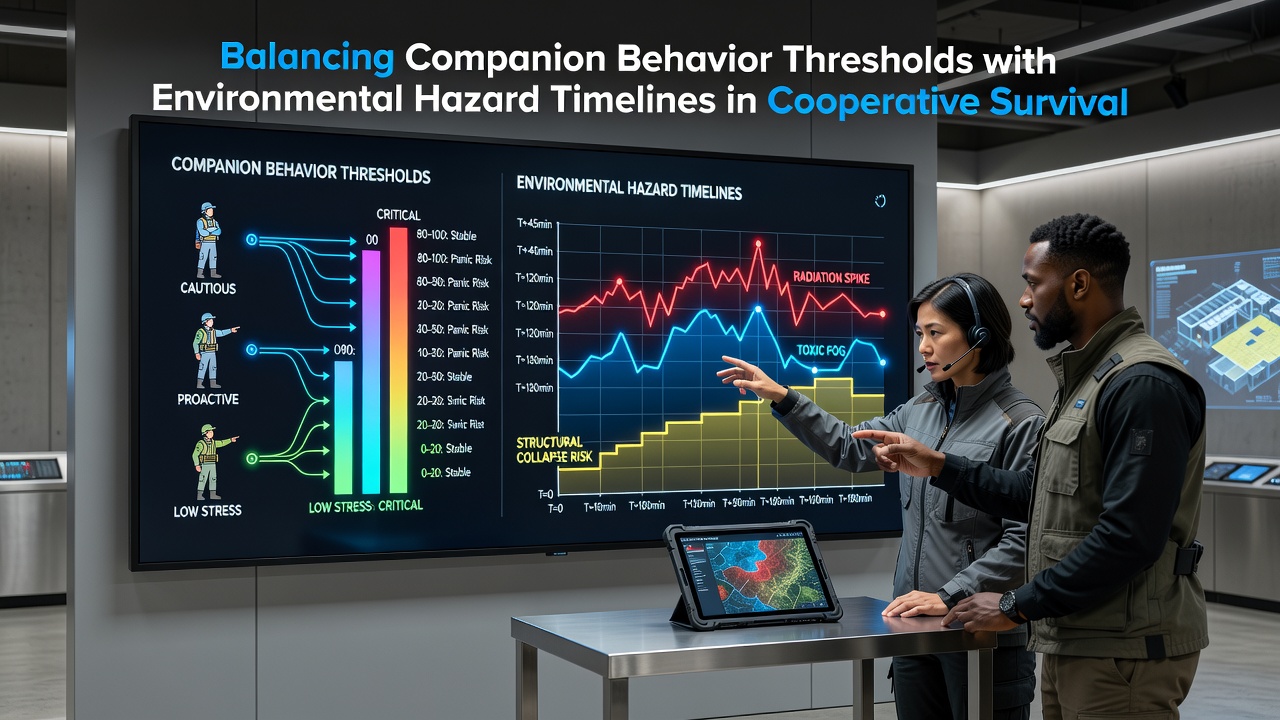
Companion behavior thresholds operate as numerical boundaries that trigger state changes, and studies from game design institutions show these values often derive from variables including current group cohesion, individual health metrics, and accumulated stress points accumulated during prior encounters. When a hazard timeline reaches a critical point, such as a wildfire spreading across 40 percent of the map area within a ten-minute window, companions evaluate their thresholds in real time and shift from offensive positioning to defensive clustering or pathfinding toward safer zones, yet players retain options to influence these shifts through commands that temporarily adjust the threshold values by small increments like 15 percent for short durations.
Integration with Hazard Progression
Environmental hazards follow structured timelines that incorporate both predictable phases and randomized accelerations, and data from industry reports reveals that effective implementations synchronize these phases with companion decision trees so that a rising water level might prompt companions to prioritize elevated terrain only after the hazard crosses a midpoint threshold, thereby preventing premature flight that disrupts cooperative objectives. Observers note that this synchronization prevents scenarios where companions abandon the group too early, and it instead encourages players to manage inventory weight and route efficiency in tandem with the hazard clock, as seen in procedural maps where biome transitions align with companion stamina depletion rates.
Designers frequently employ feedback loops that update companion thresholds based on real-time hazard data, for example lowering a fear threshold when a storm intensifies beyond expected parameters or raising an aggression threshold during brief safe windows between hazard peaks, and this approach appears in multiple cooperative titles released through 2025 with further refinements projected for September 2026 updates that introduce multi-hazard overlaps in expedition modes.
Implementation Strategies Across Game Engines
Engine-level tools allow creators to define hazard timelines as modular scripts that broadcast events to companion AI modules, and according to the Entertainment Software Association such modular approaches have become standard in titles emphasizing group coordination because they permit independent tuning of threshold sensitivities without disrupting overall expedition pacing. Those who've analyzed production pipelines discover that collision mesh variations and particle density shifts often feed into these systems as secondary inputs, enabling companions to anticipate spawn cycles or terrain changes that accompany primary hazards like earthquakes or toxic gas releases.
Memory allocation patterns in console ports further influence how frequently threshold checks occur, since resource-constrained environments limit the frequency of AI decision tree evaluations to maintain frame pacing, and reports from the International Game Developers Association indicate that developers compensate by precomputing hazard progression curves that companions reference at lower computational cost. This method ensures consistent behavior across platforms while preserving the illusion of reactive intelligence during intense cooperative sequences.
Player Interaction and Adaptation Patterns
Players interact with these systems through input buffers and command layering that can override default companion responses for limited periods, and evidence from player telemetry studies shows successful expeditions correlate with groups that synchronize their actions to hazard timelines rather than relying solely on companion initiative. Adaptive frameworks in persistent online worlds allow thresholds to evolve across multiple sessions, incorporating data from prior failures such as companions reaching panic states too quickly in repeated flood events, which leads to incremental adjustments that carry forward into new expeditions.
What's interesting is how these mechanics intersect with inventory management and route planning, since exceeding weight thresholds can delay companion movement enough to miss safe windows in hazard timelines, forcing teams to discard items strategically or reroute through areas with lower particle density for better visibility. Research indicates that games incorporating vibration pattern feedback from controllers help players anticipate companion state changes before they fully manifest, adding a layer of predictive coordination during fast-paced segments.
Conclusion
Balancing companion behavior thresholds with environmental hazard timelines remains a foundational element in cooperative survival expeditions, and ongoing refinements continue to shape how these systems support both individual agency and group success across diverse game platforms and release schedules.