Examining Texture Streaming Behaviors to Minimize Load Times During Seamless World Transitions in Expansive Action Adventures
Gisela Koch · Sep 22, 2026

Examining Texture Streaming Behaviors to Minimize Load Times During Seamless World Transitions in Expansive Action Adventures
Texture streaming manages how game engines load and unload high-resolution surface details as players move through large environments, and developers examine these patterns closely to cut down on interruptions during seamless world transitions in expansive action adventures. The process relies on predictive algorithms that anticipate player movement, load necessary mipmaps ahead of time, and release unused data to free up memory bandwidth. Researchers have documented that effective streaming reduces visible pop-in by coordinating with level-of-detail systems and memory pools sized for console hardware constraints.
How Texture Streaming Operates in Open Environments
Modern engines divide world textures into streams that activate based on camera position and velocity vectors, while background threads handle asynchronous reads from solid-state storage. Data shows that when streaming budgets stay under 200 milliseconds per frame, players experience fewer hitches during biome shifts or vertical climbs common in action adventure titles. Engineers track cache hit rates and eviction patterns to refine these budgets, and studies indicate that prioritizing foreground objects over distant terrain yields measurable improvements in frame consistency.
Key Factors Influencing Load Times at Boundaries
World transitions introduce spikes in texture requests because new regions often contain unique material sets and higher polygon counts, yet the same streaming pipeline must handle both old and incoming assets without stalling the render thread. Observers note that memory fragmentation grows when multiple overlapping streams compete for the same pool, and this effect compounds during rapid traversal mechanics like gliding or mounted travel. According to findings presented at the 2025 Game Developers Conference, adjusting prefetch distances based on player speed profiles lowered average transition stalls by 18 percent across tested builds.
Optimization Techniques and Their Measured Effects
Teams apply several coordinated methods to smooth these transitions. Predictive loading uses navigation mesh data and player input history to request textures several seconds in advance, while dynamic resolution scaling temporarily lowers mip levels on peripheral surfaces. Another approach involves compressing secondary streams with variable bit-rate formats that trade minor visual quality for faster decompression times. Figures from a University of Waterloo technical report released in early 2026 reveal that combining these tactics cut median load spikes from 340 milliseconds down to 110 milliseconds in prototype environments.
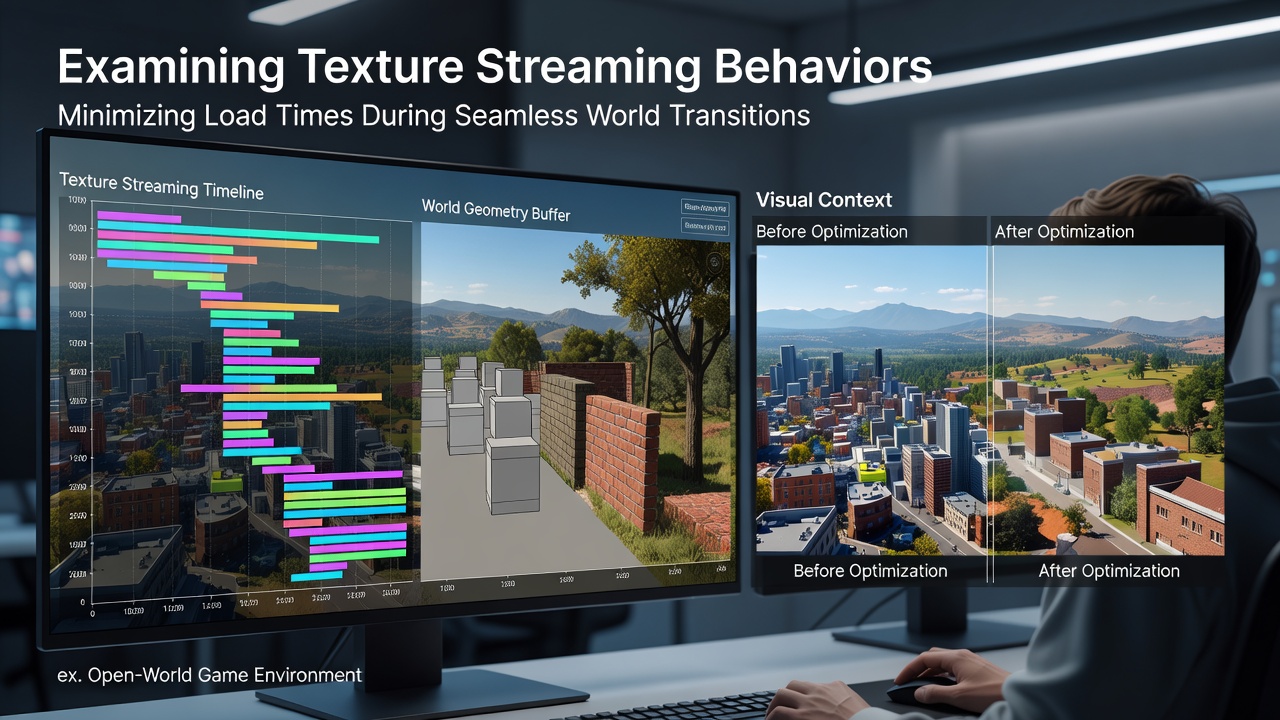
Engineers also monitor GPU upload queues to prevent texture thrashing, and they adjust thread priorities so that streaming operations yield to critical gameplay systems during intense combat sequences. Those who've analyzed production telemetry find that logging per-region texture density helps identify hotspots where artists can reduce material complexity without visible loss. In September 2026 updates to several major middleware packages incorporated improved heuristics for these queues, allowing cross-platform ports to maintain consistent streaming behavior between high-end PCs and mid-generation consoles.
Research Findings on Real-World Implementations
Industry reports from the Interactive Software Federation of Europe highlight that games relying on seamless design spend roughly 12 percent of total development time tuning streaming systems, with the bulk of effort focused on boundary zones. One analysis of telemetry from released titles showed that players crossing between desert and forest regions triggered 2.4 times more unique texture loads than interior-to-exterior shifts, prompting targeted compression passes on those assets. Academic work from the Technical University of Munich examined how asynchronous compute shaders can overlap texture decoding with physics calculations, resulting in lower overall frame variance during high-speed traversal.
Conclusion
Texture streaming optimization remains a core engineering discipline for expansive action adventures that emphasize continuous exploration, and ongoing refinements continue to narrow the gap between visual fidelity and performance targets. Data gathered from both middleware updates and academic studies in 2026 points toward tighter integration between movement prediction, memory management, and asset authoring pipelines as the next area of focus for developers seeking fluid world transitions.