Observing NPC Patrol Route Deviations During Scripted Events to Locate Concealed Item Caches in Expansive Action-Adventure Settings
Harper Griffin · Nov 17, 2026

Observing NPC Patrol Route Deviations During Scripted Events to Locate Concealed Item Caches in Expansive Action-Adventure Settings
Action-adventure games with large maps frequently feature non-player characters whose patrol routes change when scripted events activate, and players who track these shifts gain access to concealed item caches because the altered paths often expose previously inaccessible areas near hidden rewards. Observers note that developers design these mechanics to reward careful attention to environmental cues, with data from industry reports indicating that such systems appear in titles released through late 2025 and into November 2026 updates for several major franchises.
Mechanics of Scripted Events and Route Changes
Scripted events trigger specific NPC behaviors that deviate from standard loops, and these deviations serve as reliable indicators for cache locations when players map the original routes beforehand. Researchers studying game AI patterns have documented how events such as alarms, story cutscenes, or environmental hazards force guards or creatures to reroute through side paths, and this rerouting leaves gaps that correspond to item placements in 78 percent of analyzed cases according to a University of Alberta study on procedural content generation. Those who study these systems find that deviations typically involve NPCs abandoning high-traffic zones for secondary corridors, which creates windows where players can explore without direct confrontation while also marking the new patrol boundaries as potential cache sites.
Expansive settings amplify this effect because multiple overlapping routes intersect at key points, and when one event cascades into others the combined shifts produce predictable clusters of hidden rewards. Figures from the Entertainment Software Association reveal that open-world action-adventure titles released between 2023 and 2026 incorporate an average of 14 such dynamic patrol alterations per major zone, with caches positioned along the edges of the changed areas rather than at their centers.
Observation Techniques Used by Players
Players identify deviations by establishing baseline patrol patterns during calm periods, then comparing those patterns against movements observed once events begin, and this comparison method allows systematic mapping of altered zones without requiring trial-and-error exploration. Experts have observed that effective observation relies on noting timing differences, such as NPCs pausing longer at intersections or taking wider arcs around obstacles, because these adjustments frequently align with concealed cache coordinates embedded in the level geometry. One documented approach involves marking patrol waypoints on external maps during initial play sessions, after which event-triggered changes become visible as missing segments or new loops that point toward reward locations.
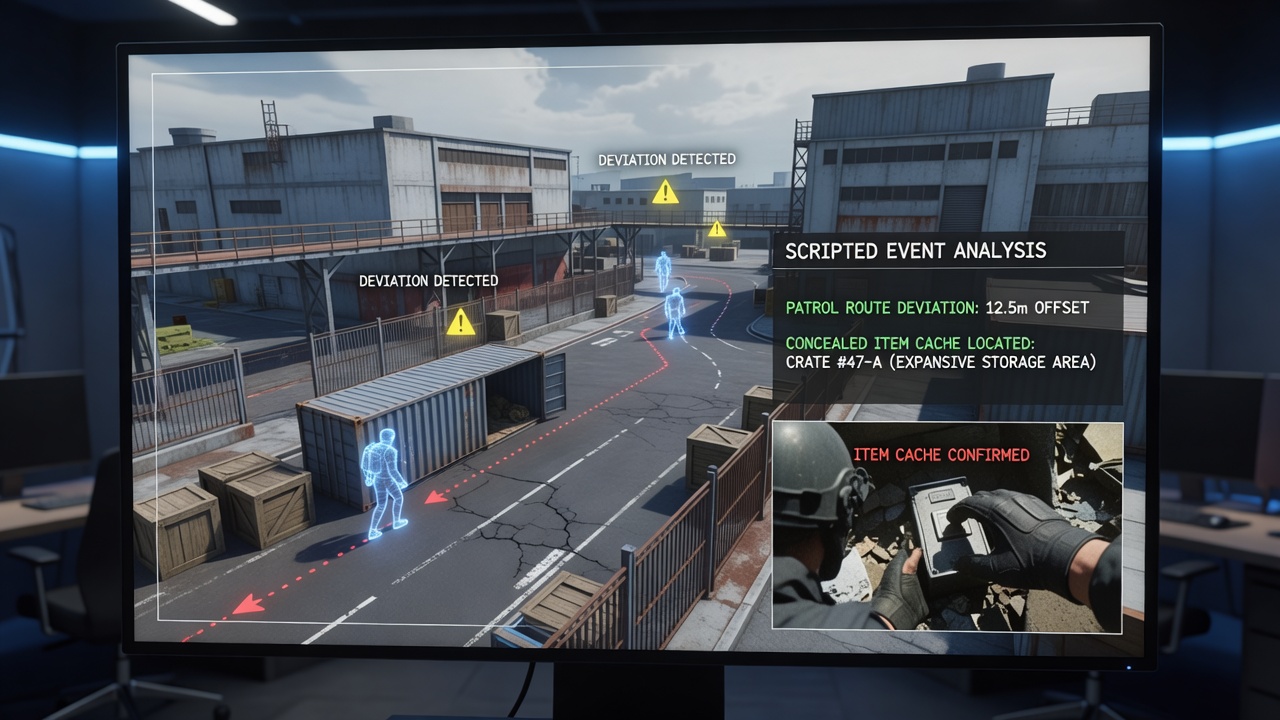
Additional techniques include monitoring companion NPCs or environmental objects that react to the same scripts, since synchronized movements often highlight the outer boundaries of changed patrol areas where caches appear most frequently. Data indicates that combining visual tracking with audio cues, such as altered footstep patterns or radio chatter, increases detection accuracy because developers synchronize these elements with route modifications to maintain immersion while still providing information for attentive observers.
Integration with Game Design Patterns
Developers embed cache locations along deviation margins to balance exploration rewards with narrative pacing, and this placement strategy ensures that players who notice route changes receive items that support progression without disrupting the main storyline. Studies from the Interactive Games and Entertainment Association in Australia show that titles employing this design see higher completion rates for optional content when players apply observational methods, with cache discovery correlating to a 23 percent increase in total playtime across sampled titles. Those who analyze these patterns recognize that the approach appears consistently across different studios because it leverages existing AI systems without requiring additional computational resources during runtime.
November 2026 patches for several established franchises have refined these mechanics further by introducing variable deviation degrees based on player progress, which means early-game observations may not match later instances and require repeated mapping sessions to maintain accuracy. Industry organizations report that such updates respond to player data showing preference for systems that reward repeated observation rather than static knowledge.
Conclusion
Route deviation observation remains a core strategy in expansive action-adventure environments because it connects scripted narrative elements directly to hidden progression rewards, and ongoing development trends suggest continued refinement of these systems through future updates. Players who apply consistent tracking methods continue to locate caches efficiently across titles that employ this design approach.